
Your LinkedIn profile is your personal marketing engine. It needs to tell recruiters the value, skills, and experience that you will bring to their organization. That means that you have to be clear in your own mind exactly what your value and skills are!
If you start with a compelling resume, it can do a lot of the heavy lifting. But LinkedIn has other aspects that you’ll need to pay attention to if you want to get the most out of this valuable platform.
Use this step-by-step guide to optimize your profile, maximize your impressions, and stand out in the competitive landscape of finance, data analytics, consulting, and policy
Visual First Impressions: Photo & Banner
A photo is important because it helps recruiters make a personal connection which makes them more likely to reach out or invite you for an interview. UCC offers a professional photo booth so that you can make that first impression count
The Professional Headshot
- The Criteria: Your photo should be a high-quality, well-lit headshot where you are dressed in professional attire (business casual or business professional). Smile, look directly at the camera, and ensure your face takes up about 60% of the frame.
- How to do it: Tap your profile photo slot to upload. If you can’t get to UCC’s photo booth, use a modern smartphone with "Portrait Mode" against a plain or softly blurred background.
The Background Banner
- The Criteria: Do not leave this as the default grey/blue constellation. Use a custom banner that reflects your academic or career interests.
- ECON-Specific Ideas: A clean stock image of a financial district, a subtle data visualization graphic, the Federal Reserve building, or a sleek geometric pattern matching UMD colors.
The Hook: Headline & URL Customization
Crafting Your Headline
- The Criteria: Move beyond the default "Economics Student at University of Maryland". Your headline should position you for the job you want, showcasing your sub-fields and technical skills.
- The Formula: [Target Role / Major] | [Key Technical Skills] | [Specific Interest or Leadership]
- Examples:
- Economics Student & Aspiring Data Analyst | Proficient in R, Stata, & SQL | Fed Challenge Competitor
- Honors Economics Major at University of Maryland | Corporate Finance & Financial Modeling | Incoming Analyst Intern
- How to do it: Click the pencil icon on your intro card to edit your headline.
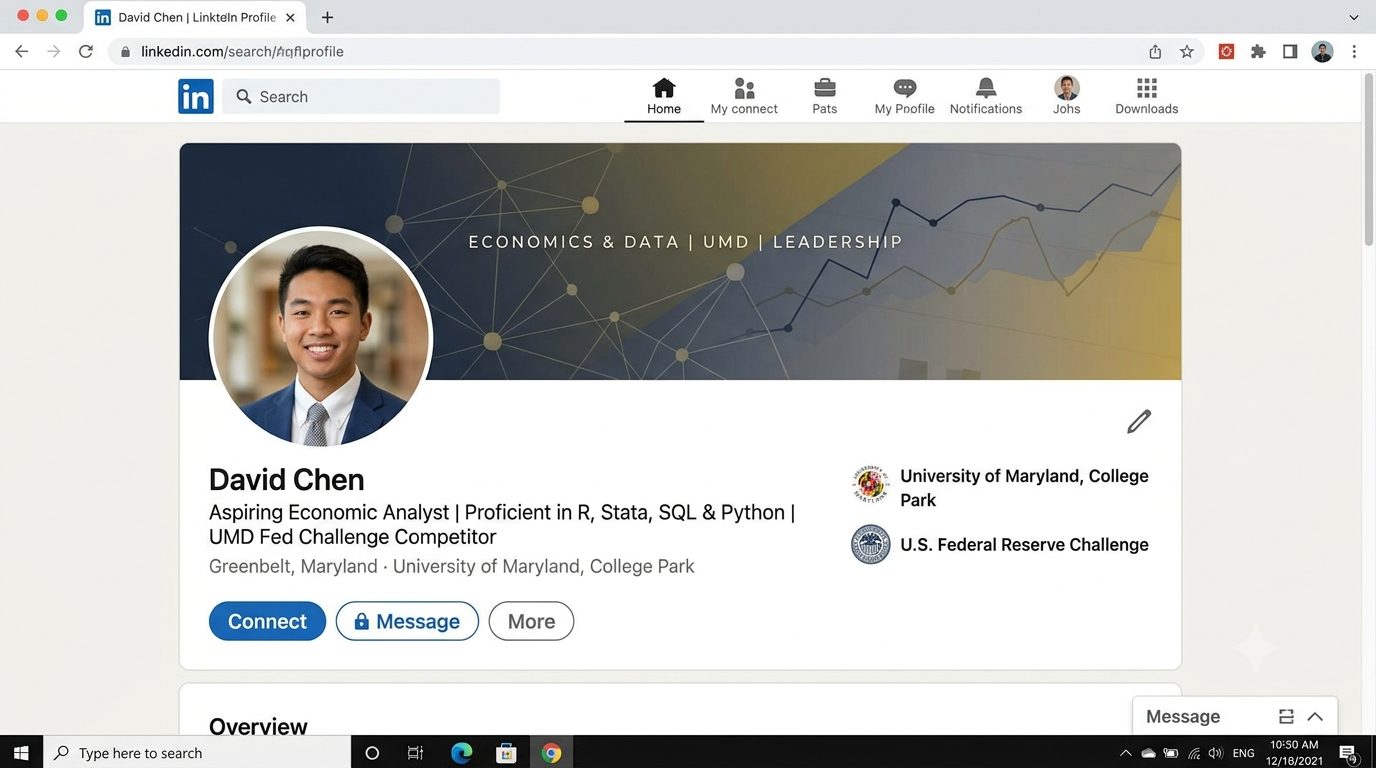
This Gemini-created image (created to show a relevant example while maintaining our students’ privacy) is an example of how these suggestions work in practice.
URL Customization
- The Criteria: Clean up the string of random numbers at the end of your default link. It should ideally be linkedin.com/in/firstnamelastname.
- How to do it: 1. View your profile.
- 2. Click "Public profile & URL" in the top right corner.
- 3. Click the pencil icon under "Edit your custom URL."

This screenshot of Ronda Ansted’s business LinkedIn profile shows how to create a customized URL.
The Pitch: "About" Summary
Think of your "About" section as your elevator pitch. It’s where you connect the dots of your coursework, skills, and career goals. Since recruiters rarely read more than the first 3 lines of the “About” section, you want to front-load your most relevant and impressive skills and experience.
The Criteria
Write in the first person ("I"). Keep it to 3–4 brief paragraphs. Crucially, it must include keywords that recruiters search for (e.g., econometrics, data visualization, market research, forecasting), especially in the first 3 lines.
The Structure
- The Hook: Who you are and what drives your analytical curiosity.
- The Toolkit: Mention the specific economic concepts and software tools you excel in.
- The Trajectory: What kind of roles/internships you are looking for.
Example
I am a data-driven Economics student who translates complex, messy datasets into clear, actionable business strategies. While many can run data models, my background in economics means I focus on the why. I understand the behavioral drivers, market forces, and causal relationships behind the numbers.
Recently, I extracted and cleaned a dataset of 50,000+ e-commerce transactions using SQL and Python. By building a multivariate regression model, I isolated a friction point in the user experience responsible for a 12% drop in checkout retention and visualized these insights in an interactive Tableau dashboard for my manager.
I am eager to bring my emphasis on statistical rigor, programming skills, and data storytelling to an entry-level Data Analyst or Business Intelligence Analyst role.
The Proof: Accomplishment-Focused Experience
Recruiters don't want to read a list of your daily chores; they want to see the impact of your work.
- The Criteria: In your Experience, Projects, and Education sections, use strong action verbs and quantify your achievements with numbers wherever possible.
- The SOAR Method: Describe the Situation, Obstacle, Action, and Result.
- Weak Description: "Responsible for updating the EAM members spreadsheet and helping out with events."
- Accomplishment Focus: "Managed database tracking for 150+ Economics Association of Maryland members using Excel; optimized event marketing strategies to increase event attendance by 25% year-over-year."
- Leverage Your Resume: If you've created your resume following our recommendations on How to Write a Compelling Resume, you can copy and paste your strongest and most relevant bullet points.
Algorithmic Boosters: Skills, Accuracy, & Assets
Skills Section & Endorsements
- The Criteria: List at least 5–10 highly relevant skills. LinkedIn’s search engine heavily weighs this section when showing candidates to recruiters.
- Top Skills for ECON Students:
- Hard Skills: Econometrics, Stata, R, Python, SQL, Tableau, Financial Analysis, Data Visualization.
- Soft/Domain Skills: Quantitative Research, Analytical Thinking, Communication
- How to do it: Scroll down to the Skills section, click the "+" icon, and add terms. Pin your top three most relevant skills to the top.
Additional Information (Show, Don't Just Tell)
- The Criteria: LinkedIn allows you to feature media that a standard resume cannot hold. Add links to your GitHub repository, Tableau dashboards, or an exceptional term paper/senior thesis.
- How to do it: Use the "Featured" section (click "Add profile section" > "Recommended" > "Add Featured"). You can link to external websites or upload PDFs.
Consistency and Accuracy
- The Criteria: Your job titles, dates, and graduation timelines must align with your paper resume. A single mismatch can raise a red flag for a meticulous recruiter. Ensure it is free of typos since analytical roles require fastidious attention to detail.
Activating Your Profile: How to Make the LinkedIn Algorithm Work for You
Once your profile is optimized, you cannot just sit back and wait for opportunities to fall into your lap. You need to understand and engage the LinkedIn algorithm. LinkedIn operates on a network effect: the more connected you are, the more visible your profile becomes to recruiters searching for talent.
Here is your systemic playbook for turning your profile into an outbound networking engine.
1. Identifying and Systematically Following Target Organizations
Do not randomly apply to hundreds of jobs. Instead, target 15 to 20 "Dream Companies" across three tiers (e.g., Tier 1: Goldman Sachs/McKinsey; Tier 2: Regional Banks/Economic Consultancies; Tier 3: High-growth data startups).
- How to do it: Search for your target companies and click the "Follow" button on their corporate page.
- The Algorithmic Benefit: When you apply for a job on LinkedIn, the Recruiter dashboard explicitly highlights candidates with a tag that says: "Signals Interest / Follows Your Company." Recruiters actively prioritize these applicants because they are statistically more likely to accept an offer.
- Turn on Alerts: On the company's LinkedIn page, click the bell icon 🔔 to get notified when they post new jobs, press releases, or articles. This gives you immediate talking points for networking calls.
2. The Art of Connecting with Recruiters (Without Being Annoying)
Do not click "Connect" on a recruiter’s profile without a message, and never send a message that just says "Here is my resume, please find me a job." Treat it like an informational interview request.
How to Find Them:
In the LinkedIn search bar, type: [Company Name] + "University Recruiter" OR "Talent Acquisition" OR "Hiring Manager Finance". Filter by "People."
The 300-Character Pitch Template:
When you click "Connect," always select "Add a note." Keep it brief, professional, and value-oriented:
"Hi [Recruiter Name], I’m a senior ECON major at the University of Maryland, tracking [Company's] recent work in market analytics. I noticed your team is expanding its summer analyst cohort. I’ve recently optimized my profile with my Python/econometrics projects and would love to connect to stay abreast of future openings!"
3. The Strategy of Scale: Why Connection Count Matters
On LinkedIn, your network density dictates your visibility. If a recruiter searches for "Data Analyst Intern + Stata," LinkedIn ranks candidates based on proximity.
Here is what your connection count signals to the algorithm and recruiters:
- The 12-Connection Trap (Invisible): If you only connect with a few close friends, you are virtually invisible. You will only show up in search results for people directly connected to those 12 individuals. Your network's reach is highly restricted.
- The 50-Connection Milestone (The "Student" Tier): This is the baseline required to look like an active user. At 50 connections, your 2nd-degree network (friends of friends) expands exponentially, meaning you will start appearing in sidebar recommendations for recruiters at local firms.
- The 500+ Magic Number (The "Professional" Tier): Once you pass 500 connections, LinkedIn stops displaying the exact number and simply shows "500+ connections." * Why it matters: This is a psychological green flag for recruiters, signaling that you are highly networked and serious about your career.
- The Algorithmic Boost: At 500+ connections, your 3rd-degree network expands into millions of professionals. When a recruiter at a major firm searches for applicants, the algorithm favors profiles with a high volume of mutual or extended connections.
4. Systematically Growing Your Contacts
To hit that 500+ milestone quickly and organically, commit to a "5-a-Day" habit. Every day, send five personalized connection requests to the following three buckets:
- Alumni from your University: Search University of Maryland's LinkedIn page, click the "Alumni" tab, and filter by your target city or target company. Alumni have an incredibly high response rate because of the shared affinity.
- Professionals in your Target Roles: Look for people who graduated 1–3 years ago holding the exact job you want (e.g., "Junior Financial Analyst at Vanguard"). Ask them for an informational interview about how they made the transition.
- Your Peers: Connect with every single student in your Economics classes, your professors, and members of your university clubs. They will graduate and scatter into companies across the country creating a growing, highly valuable web of future referrals.